Introduction
AI is in the classroom whether your school has a policy on it or not. Students are using it for homework. Teachers are experimenting with it for planning. The question is no longer “should we engage with AI?” but “how do we engage with it well?”
The answer is AI literacy: the skills, knowledge, and critical awareness that both staff and students need to use AI safely, ethically, and effectively. Below is a practical two-part checklist — one for teacher AI literacy, one for student AI literacy — that schools can use as a framework for training, policy development, and classroom practice.
Part 1: Teacher AI Literacy Checklist
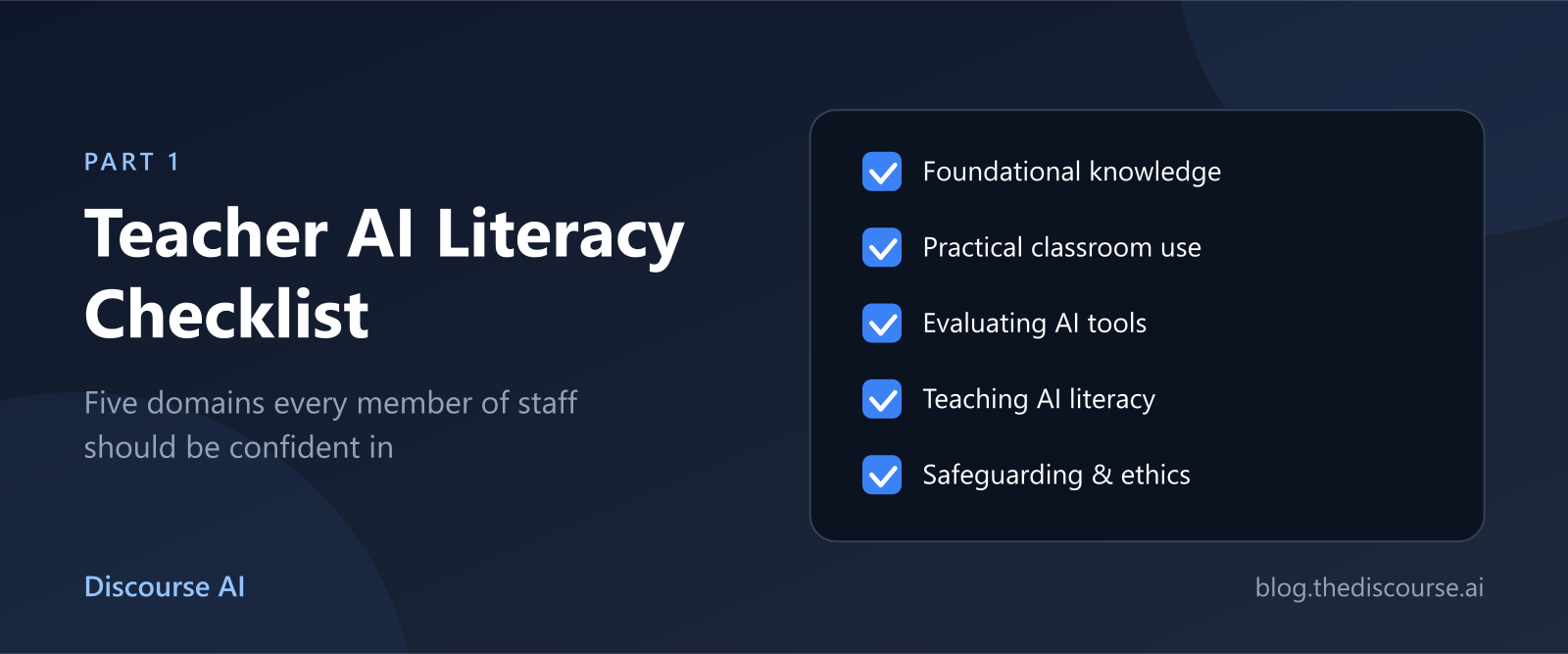
Foundational Knowledge
- ☐ I can explain what AI is and what it is not, including the difference between generative AI (like chatbots) and analytical AI (like learner analytics dashboards).
- ☐ I understand that large language models are pattern-matching tools, not truth-seeking tools. They predict the next likely word. They do not know things.
- ☐ I can name at least three limitations of current AI: hallucination, bias in training data, and inability to reason.
- ☐ I understand that AI output quality depends on the quality of the input — vague prompts produce vague results.
Practical Classroom Use
- ☐ I can write a structured prompt that includes context, audience, format, and tone, and I know how to iterate on the output rather than accepting the first response.
- ☐ I have identified at least two specific tasks where AI saves me time: lesson planning, resource creation, differentiation, quiz generation, report drafting, or administrative paperwork.
- ☐ I know how to verify AI-generated content before using it with students — checking facts, spotting outdated references, and identifying bias.
- ☐ I can use AI to generate varied examples, alternative explanations, and scaffolded materials for learners who need additional support.
Evaluating AI Tools
- ☐ Before using any AI tool with students, I check: Where is the data stored? Is it GDPR-compliant? What is the minimum age requirement?
- ☐ I know the difference between an AI tutor built on pedagogical principles and a general-purpose chatbot, and I choose tools accordingly.
- ☐ I understand whether the AI tool I am using trains on user data. If it does, I do not input student work or personal data.
- ☐ I can assess whether an AI tool replaces student thinking or extends it — and I choose tools that extend.
Teaching AI Literacy to Students
- ☐ I have explicitly taught my students what AI is, how it works, and what its limits are — not as a one-off assembly but as part of regular practice.
- ☐ I model critical use of AI in front of students: checking outputs aloud, questioning sources, and discussing when AI got something wrong.
- ☐ I can explain to students why struggling with a problem before asking AI is valuable, not punitive.
- ☐ I have established clear classroom rules about when AI use is appropriate and when it is not, and these rules are shared with parents.
Safeguarding and Ethics
- ☐ I understand the specific safeguarding risks AI introduces: deepfake content, AI-generated misinformation, chatbot dependency, and data privacy breaches.
- ☐ I know my school’s reporting procedure for AI-related safeguarding incidents.
- ☐ I can help students evaluate AI-generated content critically: Who made this? What data was it trained on? What perspective is missing?
- ☐ I am aware of algorithmic bias and can give students concrete examples — biased image generation, Western-centric knowledge gaps, and stereotyped outputs.
Part 2: Student AI Literacy Checklist
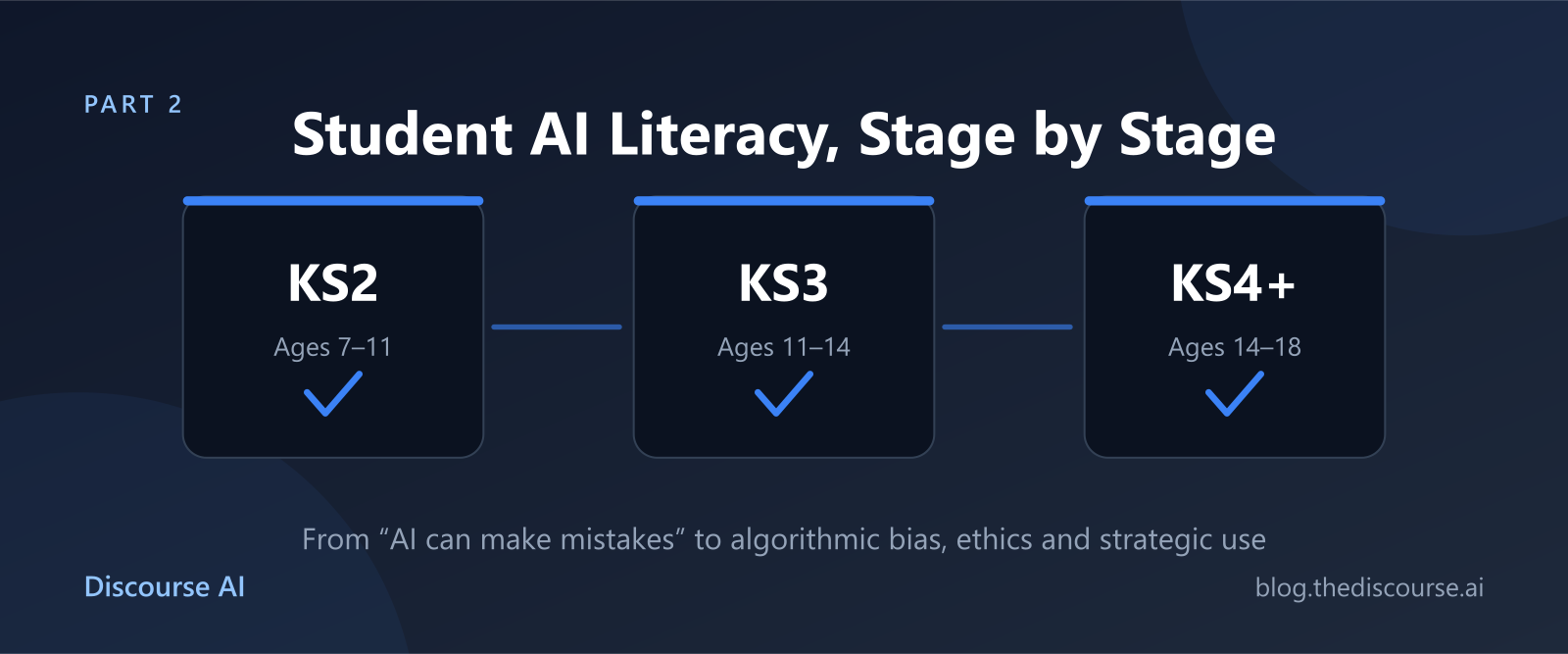
Key Stage 2 (Ages 7–11)
- ☐ I know that AI is a computer programme that learns from examples, not a person who thinks.
- ☐ I understand that AI can make mistakes and sometimes makes things up.
- ☐ I know never to share personal information with an AI tool.
- ☐ I can tell the difference between something I wrote myself and something AI helped with — and I know to tell my teacher which is which.
- ☐ If an AI says something that upsets or worries me, I know to tell a trusted adult.
Key Stage 3 (Ages 11–14)
- ☐ I can explain what a large language model is in simple terms.
- ☐ I understand that AI training data comes from the internet and reflects both its strengths and its biases.
- ☐ I know how to write a clear prompt and how to refine it if the output is not what I need.
- ☐ I treat AI output as a draft, not a final answer — I verify facts, question assumptions, and check for bias.
- ☐ I understand that using AI to do my thinking for me means I miss the learning. AI should support my effort, not replace it.
- ☐ I can identify three ways AI-generated content might be misleading: fake statistics, invented quotes, outdated information, or biased framing.
- ☐ I know my school’s policy on AI use for homework and assessments, and I follow it.
Key Stage 4 and Sixth Form (Ages 14–18)
- ☐ I can evaluate an AI tool critically: Who built it? What is their business model? Where does my data go?
- ☐ I understand the concept of algorithmic bias and can give specific examples — such as image generators producing stereotypical outputs or language models defaulting to American cultural references.
- ☐ I use AI strategically: as a study partner for quizzing and retrieval practice, as a writing assistant for structure and feedback, and as an explainer for difficult concepts — not as a shortcut to skip the work.
- ☐ I know how to cite AI use appropriately in my academic work.
- ☐ I am aware of the environmental impact of large-scale AI and can discuss the trade-offs involved.
- ☐ I can have an informed conversation about AI ethics: job displacement, surveillance, deepfakes, and the concentration of AI power in a small number of companies.
- ☐ I understand that the skills most valued in an AI-saturated world are the ones AI cannot replicate — critical thinking, creativity, collaboration, and ethical judgement — and I actively develop those skills.
How Discourse AI Builds AI Literacy by Design
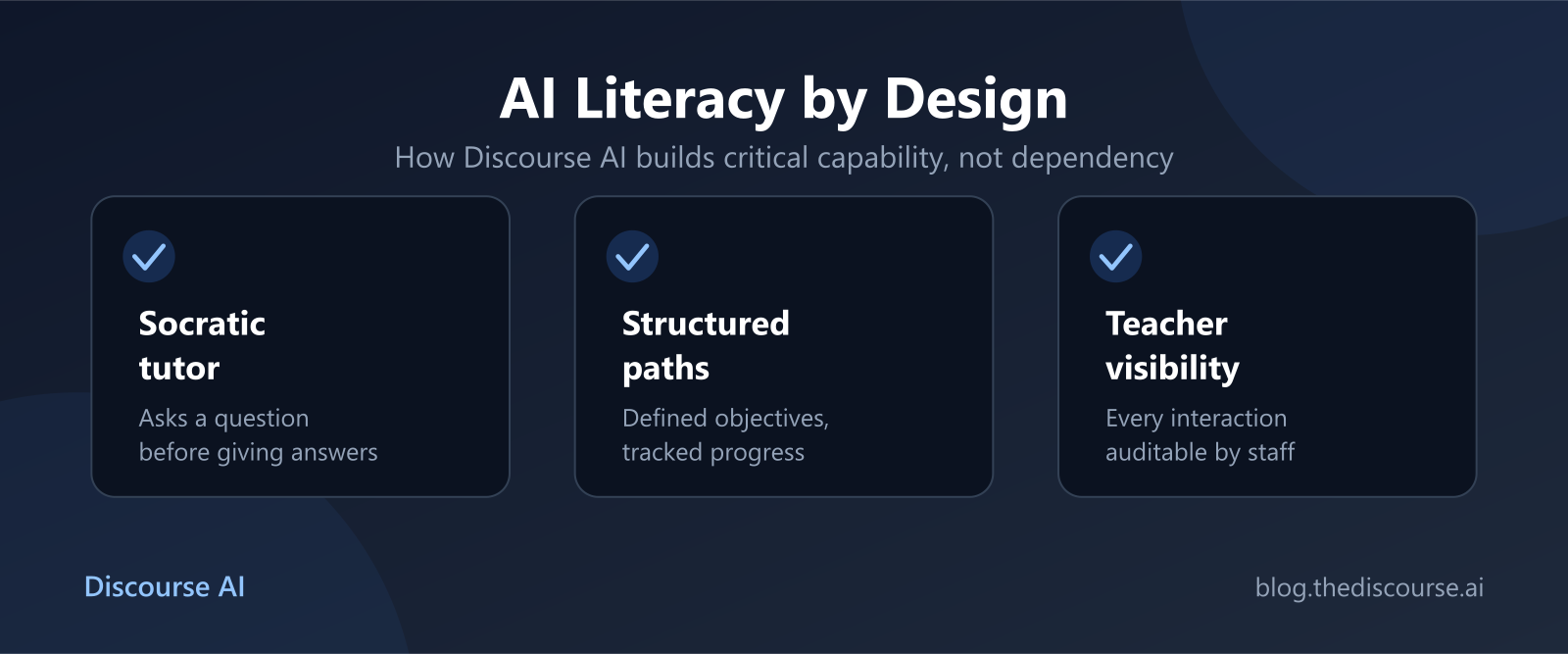
Discourse AI was built by a classroom teacher who understood that the goal is not to make students dependent on AI but to make them critically capable with it. Our platform reflects that in three ways:
The Socratic tutor asks before it tells. When a learner is stuck, the AI tutor responds with a diagnostic question — not the answer. This builds the habit of thinking before prompting, which is the foundation of AI literacy.
Structured learning paths with measurable outcomes. Unlike open-ended chatbots, Discourse AI produces courses with defined objectives, tracked progress, and certification. Students learn that AI is a tool for achieving goals, not a magic box that does the work.
Teacher visibility into every interaction. Staff can see exactly how learners are using the AI tutor — which topics they ask about, how often they request answers versus hints, and whether AI use is improving their outcomes. This transparency allows schools to audit AI literacy development in real time.
Download This Checklist
This checklist is available as a free downloadable resource for UK schools. Share it with your staff, use it to audit your current AI literacy provision, or adapt it into your school’s AI policy. To receive the PDF and a termly update as the AI landscape evolves, sign up below.
Download the AI Literacy Checklist →
Frequently Asked Questions
Does this checklist align with the UK government’s AI guidance for schools? Yes. The checklist aligns with Department for Education guidance on generative AI in education and the broader digital literacy requirements of the national curriculum and Keeping Children Safe in Education.
How often should we revisit AI literacy training? AI tools and capabilities change rapidly. A termly staff briefing and an annual deep-dive training session is a reasonable minimum. Student AI literacy should be embedded across the curriculum rather than taught as a standalone topic.
Do all staff need to be AI-literate, or just IT leads? All staff. AI is not a computing-department concern. It affects assessment, homework policy, safeguarding, and every subject’s pedagogy. Every teacher who sets work that could be completed or assisted by AI needs the literacy to make sound decisions.
What if our school has no AI policy yet? Start with this checklist. Use it to gauge where your staff and students currently are, identify gaps, and build a policy from the ground up. A policy that reflects actual practice and teacher input is more likely to be followed than one imposed from above.
Ready to see how Discourse AI supports AI literacy in practice? Book a demo and we’ll show you how our Socratic tutor, structured courses, and teacher dashboard help schools build the skills that matter.